Divided Highway Sign: Meaning and What to Do
The yellow diamond with opposing arrows separated by an oval warns that the road ahead divides around a median: opposing traffic moves to the other side of a physical barrier, and your side becomes one-way in your direction.
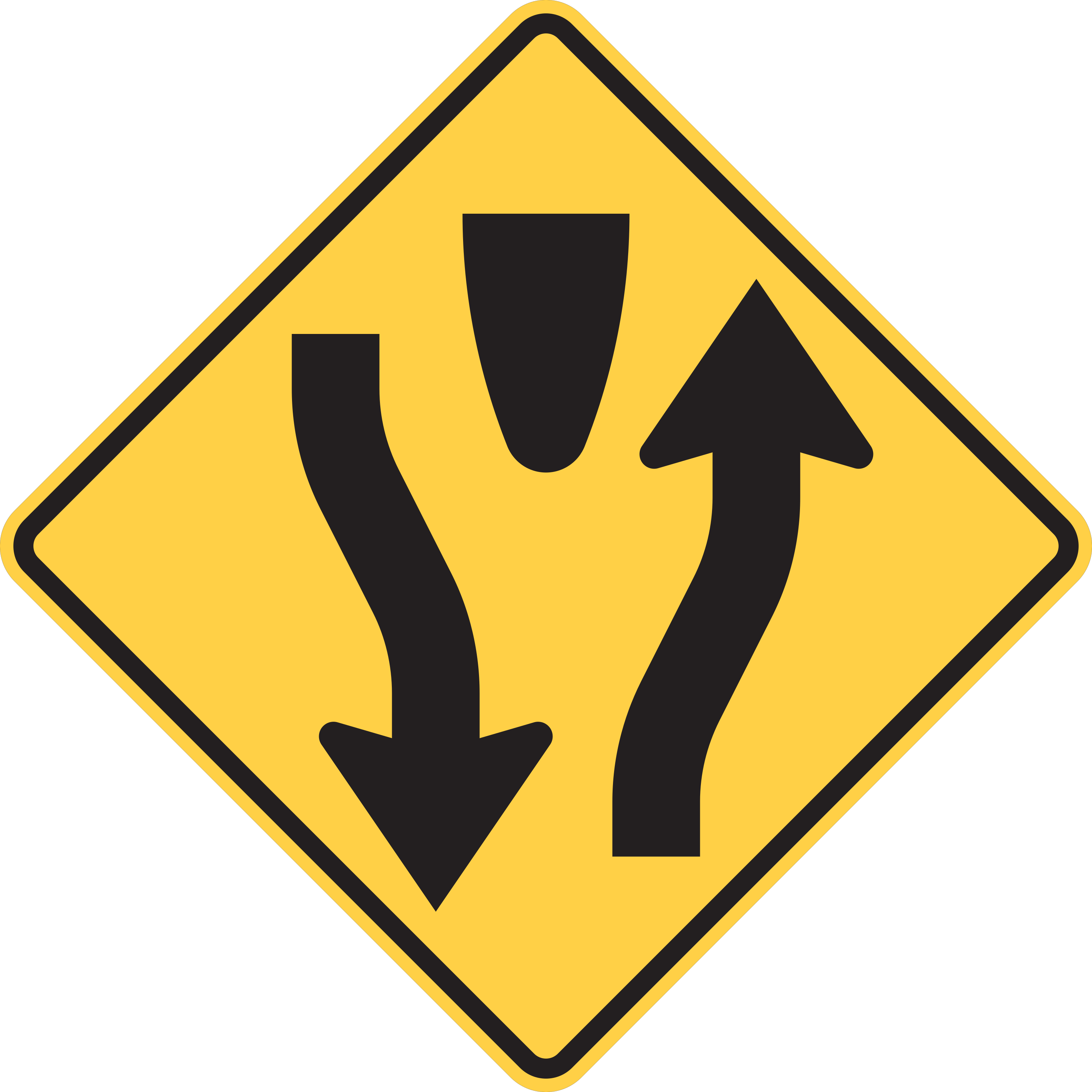
Divided Highway Sign
The transition is the tested moment: keep right of the median nose, expect Keep Right signs at the split, and remember that turning left across the median is possible only at signed openings.
What to do when you see the divided highway sign
Stay right as the road splits, treat your side as one-way, and plan left turns and U-turns for the signed median openings. Passing now happens in your own direction's lanes; the oncoming lane no longer exists on your pavement.
The signs it is confused with
The exam pairs it with Divided Highway Ends, the same symbol reversed, and with Keep Right at the median nose. Reading which end of the division you are at, beginning or ending, is the whole question.
Signs are one topic of ten on every test
Every state practice test covers signs, signals, and markings among its ten topics, with every answer explained. Pick your state and see how its exam asks about signs like this one; it is free, with no sign-up.
Choose your stateQuestions about the divided highway sign
What does the divided highway sign mean?
The road ahead splits around a median; opposing traffic moves behind a barrier and your side becomes one-way. Keep right of the median nose.
How do left turns work on a divided highway?
Only at signed median openings or intersections; between them the median is a wall. Plan the turn rather than improvising one.
What sign usually accompanies the split?
Keep Right at the median nose, marking the side to pass the obstruction on. The pair is a standard test combination.
What changes about passing?
It happens entirely in your own direction's lanes. There is no oncoming lane to borrow, which removes the head-on risk and the old passing rules with it.
How is it tested?
Against its Ends counterpart and in transition scenarios: which side to keep, where turns are possible, what the median means.